

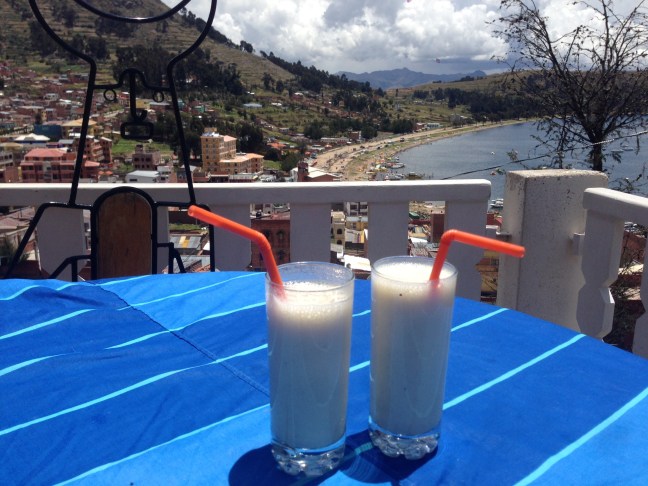
Copa… Copacabana.
Marea forbade me from singing that song while we were visiting the namesake on Lake Titicaca* (hehe), and now my privilege of even speaking of the beach-town has been revoked.
You see, Copacabana is a sleepy little town on the Bolivian side of Lake Titicaca. Many travelers skip right over the Puno, Peru side and head straight there with promises of it being the more beautiful side of the lake. And I’d have to agree wholeheartedly.
After being away from the San Diego and Jihuay coasts for so long, we were anxious to visit Puno for the warm sun and beaches of Lake Titicaca. Puno would be the highest elevation to-date, so to avoid altitude sickness, we scheduled in a couple days of rest and soak in all the gloriousness.
Puno greeted us with closed shops, rain, and a lake covered in duckweed. Sunday arrival and weather foiled us again. Exhausted from the overnight bus and our walk to the “beach” (damn altitude), we spent the day sleeping and arranging our trip to the islands the next day.
Although our hostel was more than eager (read: pushy) to book us an all-inclusivo trip to the 3 islands of Uros, Amantani, and Taquile, Marea’s thorough research protected us from giving in to what seemed easiest. I mean, a bus would pick us up in the morning right in front of the hostel!
As travelers and sometimes tourists, it’s our job to be responsible consumers especially in places where a large majority of the economy relies on tourism. To ensure your fun adventures aren’t harming the environment or exploiting the locals, a good rule of thumb is to avoid the cheapest tours and agencies despite the screams from your tight pocketbook.
In this instance, Marea warned that we needed to pay the family that’d be hosting us directly and our all-inclusivo hostel offering wasn’t going to give the family their fair cut. So, the next morning, we headed for the port and hoped for the best.
With some minor confusion (surprise, surprise), we found our way on a boat that amazingly lead us to all 3 islands and where a family took us in, fed us, and gave us a bed. Success! The first island stop was Uros, an island completely made out of reeds that floated in the middle of the lake. We received a brief tutorial on how the islands were made and how people live on them year round. I’d like to claim that I fully understood the tutorial because my Spanish is improving, but I think it might have to do with the models, diagrams, and hand gestures used in the presentation.


The second island, Amantani, was where we stayed overnight. The family was nice (turns out our boat operator was also the husband of the household), the food was delicious, and the rain held out long enough for us to hike two small mountains with absolutely stunning views. Right as we ducked inside on our return home, the skies opened up and we enjoyed quite the thunderstorm the rest of the night.


The last island of Taquile was a bit of a dud and we’d recommend skipping it altogether. It’s the island where most of the all-inclusivo tours stay overnight and it was a tourist trap as the online forums warned. But, overall, we enjoyed the island tours and decided not to rush ourselves when we returned and chilled in Puno an extra day to recoup.
Oh how I wish I would have known about the pure bliss of Copacabana before we made that decision. Puno was fine…. but Copacabana as you might have guessed was GREAT!
Before I share more love for my favorite Latin American beach town, I must mention our journey into Boliva. The bus attendant handing out everyone’s entry paperwork asked us what country we were from when it was our turn, “Que pais?” “Estados Unidos,” we replied. ” Como?!” she responded a bit flustered. Then, she turned around and walked away from us.
Wondering what we said wrong, she returned with another stack of forms for us to fill out and used her best English to explain that we’d have to pay an extra tax to enter Bolivia. “Oh.” Of course it wouldn’t be easy for us to cross the border like everyone else. We were the only US citizens aboard. Hoping we wouldn’t get left behind or denied entry, we got off the bus and headed over to the lengthy migracion line with the rest of the bus herd.
Official consulate websites informed us that our border cross into Bolivia would require no less than the following:
-Passport
-Proof of Economic Stability (ie. Bank statements)
-Invitation from Hotel/Residence (written in Spanish)
-Proof of Exit Ticket (bus/plane)
-$160 Entrance Fee (in American Dollars per person)
-Peruvian Exit Stamp
What they asked for:
-Passport
-360 Bolivianos ($50 each)
-Copy of Passport
Turns out Bolivia just dropped the cost of the reciprocity entry fee for Americans a couple weeks ago because we (USA) decided to drop the fee we charged Bolivians to enter the US. And the one thing they didn’t ask for online (the copy of the passport) was the only thing they wanted from us. Luckily, we had it and didn’t have to return to the end of the line or go back to Peru and we made it back onto our bus and into Bolivia.
Now, we thought that Peru was cheap – divide the cost by 3 for the price in American dollars – but in Bolivia, we got to divide by 7! So, you can start to understand why Copacabana was such a dream world. A land where the sun was shining bright, the beach was shimmering and bustling with locals and tourists alike, and $22 got you a room in one of the luxury hotels with a stunning beach view and the best restaurant in town. I don’t know why we ever left.


We thought Bolivia would be the place we’d save the most money for our upcoming Patagonia excursion, but with deals this hella value, we gave into our prissy American and ate out every meal, stopped splitting a single food order, devoured our own juices, and even got dessert.
We did manage to leave our luxury spot long enough for a gorgeous tour of the nearby Isla del Sol (birthplace of the sun). The tour included the usual snail boat ride over to the north of the island and we hiked (sin guia) to the south part of the island where we spent the night. Another amazing hike but I was happy to return to my jugo de plantano con leche back at our favorite spot in Copacabana.


With adventure calling our names, we reluctantly left this paradise. It was over the course of the next couple of weeks that Marea instated a ban on my reminiscing about Copacabana. Because as fun as the next places would be, they just wouldn’t be Copa… Copacabana.
*I’d like to apologize in advanced for all those followers out there who were awaiting Marea’s many witticisms referencing the name of the lake. I’m sorry for your bad luck that it’s my turn to blog. I will not attempt any jokes, otherwise, more apologies would be in order.
 The Traveling Blues
Kristy, this was great! Thanks for writing. xo
LikeLiked by 1 person
“Birthplace of the sun.” Best thing I read all day.
LikeLike
Andrea, coincidentally, the neighboring island “Isla del Lune” was the birthplace of the moon. How lucky the moon and sun were born so close together. 🙂
LikeLike
I am enjoying your blog. Brings back memories of our trip to Peru. Lake Titicaca was one of the highlights. The guide told us they now use empty 2 litre plastic soda bottles to float the islands and their boats. Hope it isn’t true. We only went to Puno in Bolivia. Looks like we need to return to Copacanbana. Beautiful!
LikeLike
Joan, although we’ve seen quite inventive ways to reuse plastic and glass, it appears they are still using the reed technique to float the islands as far as we could tell. Plus, plastic bottles weren’t in the Spanish info session. 🙂
LikeLike
You two are phenomenal planners. This is an incredible journey.
LikeLike
Copacabana looks like my kind of place! I like the easier, slow pace type of vacation. Enjoying your blog!
LikeLike